
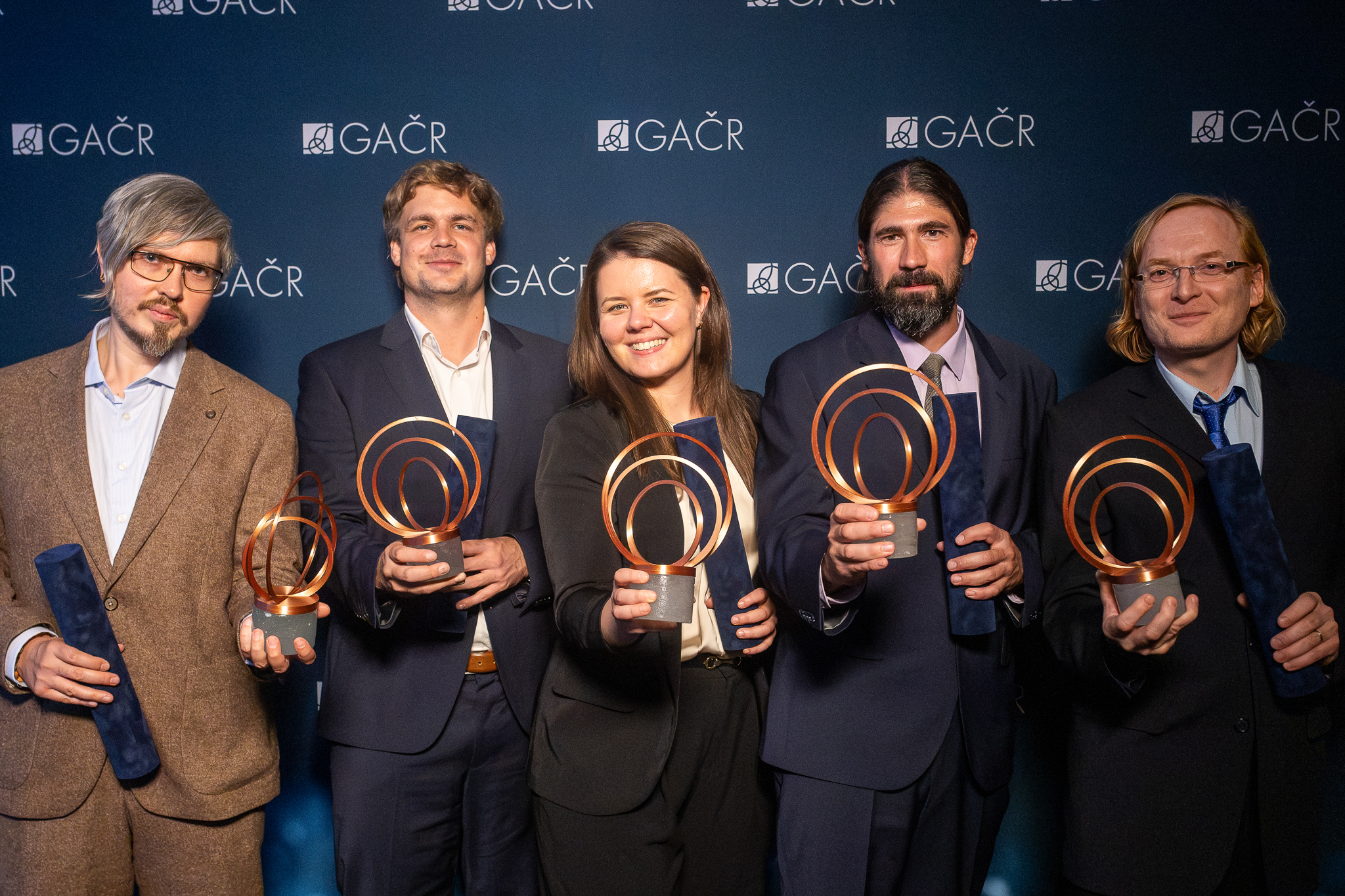
Milan Jirsa, President of the Czech Science Foundation (GACR), has honoured one female and four male scientists today whose projects produced outstanding results in basic research.
This year’s award recipients, for example, revealed previously unknown properties of Nitinol – a shape-memory alloy, developed new methods for the modification of peptides that can be used in targeted treatment, introduced more precise methods for studying ancient migrations and the mixing of human populations, showed how rulers, institutions and individuals influenced the development of society, and mapped the previously hidden world of soil fungi, which comprises up to six million species, compared with the 150,000–200,000 species described to date.
“The award recipients this year show how closely Czech science is connected to the international scientific community. Three of them came to the Czech Republic from abroad. For the first time ever, the award is also being given to the investigator of a POSTDOC INDIVIDUAL FELLOWSHIP project. Her recognition demonstrates the importance of international mobility for the development of scientific careers and Czech research institutions,” says Professor Milan Jirsa, President of GACR. “The outputs of all five award-winning projects rank among the best results in basic research in the Czech Republic and confirm that Czech science is a fully-fledged part of the global research landscape.”
POSTDOC INDIVIDUAL FELLOWSHIP grants are targeted at early-career researchers who have completed their PhD recently and support their international mobility. This grant has enabled this year’s award recipient Soňa Krajčovičová to carry out a significant part of her research at the University of Cambridge and then return to the Czech Republic, where she is establishing her own research team.
The GACR President’s Award has been awarded regularly since 2003 in recognition of outstanding results achieved through grant projects completed in the previous year. Award recipients are selected on the recommendation of several hundred scientists who evaluate projects funded by GACR. The awards are presented in five areas of basic research: technical sciences; physical sciences; medical and biological sciences; social sciences and humanities; and agricultural and biological-environmental sciences.
The President’s Award ceremony drew First Deputy Prime Minister and Minister of Industry and Trade Karel Havlíček, President of the Czech Academy of Sciences Radomír Pánek, President of the Czech Rectors Conference Milan Pospíšil, and dozens of other distinguished guests.
Award-Winning Projects
Technical Sciences
HOW A MATERIAL REMEMBERS ITS SHAPE: A NEW DISCOVERY IN NITINOL
Ing. Petr Sedlák, Ph.D., Institute of Thermomechanics, Czech Academy of Sciences
project: Tailoring strain heterogeneity on macro- and micro-scales in NiTi shape memory alloys by transformation-induced plasticity
The award-winning project provides a new perspective on Nitinol – a nickel-titanium alloy that can “remember” its shape and repeatedly return to it. Scientists have described a previously unknown mechanism of its plastic deformation, called “kwinking”. The discovery helps explain Nitinol’s exceptional ductility and may contribute to its more reliable and broader use, for example in medicine, where it is used in the manufacture of stents and heart valves.
Physical Sciences
HOW TO TURN PEPTIDES INTO MORE PRECISE TOOLS FOR BIOLOGY AND MEDICINE
Mgr. Soňa Krajčovičová, Ph.D., Faculty of Science, Palacký University Olomouc
project: Conformationally locked peptide–drug conjugates as a platform for targeted therapeutics
Peptides have great potential in the development of targeted therapeutics, but their use is often limited by their low stability and difficult chemical modification. Soňa Krajčovičová has developed new methods that make it possible to stabilise peptides, modify their function and precisely link them to antibodies. The results expand the possibilities for studying biological systems and open up new avenues for the future development of targeted therapeutics, particularly in the fields of oncology and metabolic disorders.
Medical and Biological Sciences
WHEN THE DNA MAP MISLEADS: NEW METHODS PROVIDE A MORE ACCURATE PICTURE OF HUMAN HISTORY
M.Sc. Pavel Flegontov, Ph.D., Faculty of Science, University of Ostrava
project: Genomic formation of Indo-Europeans: new approaches to genetic admixture modelling guided by simulated data
Ancient DNA offers a fascinating insight into humanity’s past, but its study can also lead to erroneous conclusions. Pavel Flegontov has developed new methods and software that help reconstruct ancient migrations and the mixing of populations more accurately. His work thus contributes to greater reliability in archaeogenetic research and challenges established paradigms.
Social Sciences and Humanities
WHO REALLY CHANGES HISTORY? RULERS, INSTITUTIONS AND ORDINARY PEOPLE
Sebastian Ottinger, Ph.D., CERGE-EI
project: The influence and origins of national and local political institutions
The project provides a new perspective on who can change society for better or worse, and under what conditions. Using historical data from Europe and the U.S., it shows that the capabilities of rulers directly influenced the prosperity of states, while parliaments were able to mitigate the damage caused by weak rulers. It also reveals how political elites used the media to spread racist propaganda and how French soldiers, after returning from the American War of Independence, helped spread democratic and revolutionary ideas in France.
Agricultural and Biological-Environmental Sciences
REVEALING THE HIDDEN WORLD OF FUNGI: THE KEY TO THE FUTURE OF SOIL, ECOSYSTEMS AND LANDSCAPES
Mgr. Tomáš Větrovský, Ph.D., Institute of Microbiology, Czech Academy of Sciences
project: Economically important fungi and organisms: distribution, diversity and human effects
Scientists have mapped the invisible world of soil fungi, which has a major impact on soil fertility, landscape health and food production. The award-winning project brought together modern DNA analyses, bioinformatics and the GlobalFungi database, providing new insights into how fungi change under the influence of humans and climate. To date, around 150,000–200,000 fungi have been described. Scientists have now estimated that there may be as many as six million species.