
A project funded by the Czech Science Foundation (GA ČR) addressed one of the construction industry’s greatest challenges: although the cement industry is gradually reducing its emissions, it still contributes substantially to global carbon dioxide production. While coarse fractions of recycled concrete are relatively easy to reuse, the fine fractions constitute a problematic waste stream.
The ambition of researchers from the Czech Technical University in Prague (CTU) and the University of Chemistry and Technology, Prague (UCT Prague) was therefore clear: to demonstrate that these fine particles can be bonded together and converted into a material of practical value, while simultaneously opening a pathway toward solid-phase carbon storage.
Biocementation as a Route to a New Material
The researchers employed microbially induced calcite precipitation (MICP), a process in which microorganisms, under specific conditions, form calcium carbonate (CaCO₃) crystals that bind the fine fractions into a solid composite specimen.
From a scientific standpoint, this was uncharted territory: the available literature contained no description of MICP technology being used to bind the finest particles of waste concrete, yet existing knowledge of biocementation offered grounds for hope that the circular economy of construction materials could be linked with biotechnology.
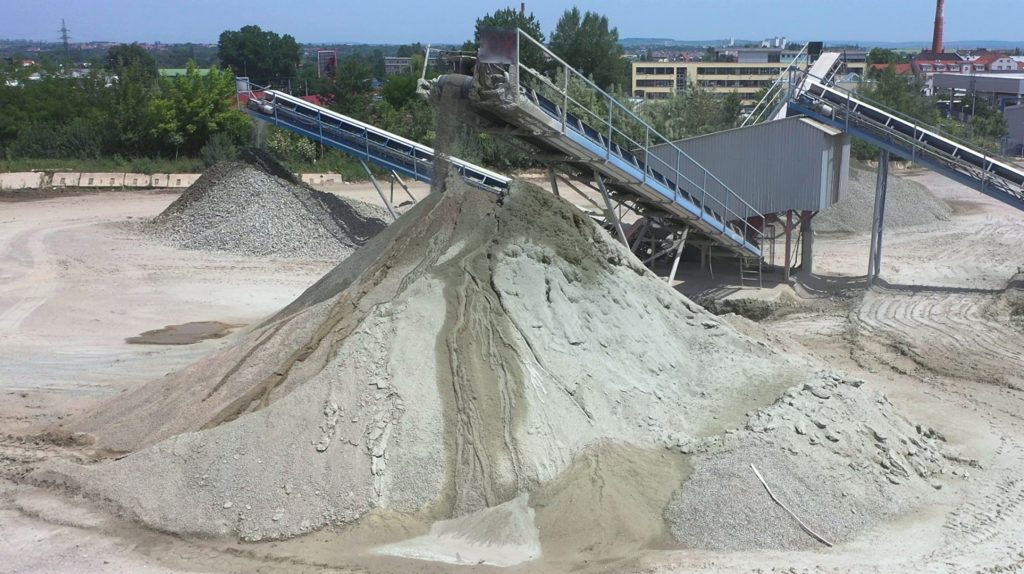
Fine fractions separated during the sorting of recycled aggregate.
Interdisciplinary Research at CTU and UCT Prague
The three-year research project encompassed a comprehensive agenda divided into four mutually interconnected areas.
At the Faculty of Food and Biochemical Technology of UCT Prague, under the leadership of Assoc. Prof. Hana Stiborová, Ph.D., the work involved selecting suitable bacterial strains, optimizing cultivation conditions, and investigating the influence of different metabolic pathways on CaCO₃ formation in suspensions of the fine fractions of recycled concrete.
At the Faculty of Civil Engineering of CTU Prague, under the leadership of the project’s principal investigator, Assoc. Prof. Václav Nežerka, Ph.D., the resulting conglomerates underwent microstructural and mechanical characterization, ranging from electron microscopy and phase analysis, through nanoindentation, to macroscopic compressive and fracture testing and subsequent micromechanical modeling.
Samples, data, and interpretations flowed continuously between the two teams, so that the biological experiments were not conducted in isolation from the materials assessment but formed a single, shared research narrative.
Collaboration between the departments and between the two universities proved essential for understanding the problem in its full depth.
Microbiologists from UCT Prague contributed expertise in bacterial cultivation, strain identification, and the assessment of, for example, urease and carbonic anhydrase activity, while materials engineers and microscopy specialists from the CTU Faculty of Civil Engineering focused on the relationship between microscopic processes and the strength of the prepared specimens.
Material for the experiments was supplied by ENVISAN GEM, a.s., and Moravostav družstvo, which made it possible to test the procedures on real waste material rather than only on laboratory model mixtures.
From Ureolytic Bacteria to More Environmentally Friendly Processes
The project gradually produced results that, in several respects, exceeded the original expectations.
In its initial stages, the work focused on ureolytic bacteria, particularly Sporosarcina pasteurii, and demonstrated that the MICP process can increase the calcium carbonate content, reduce porosity, and improve the stiffness of the material to a level of approximately one-fifth that of aerated autoclaved concrete.
Over time, however, it became apparent that a more promising route lay with the facultatively anaerobic strains Alkalihalophilus pseudofirmus and Sutcliffiella cohnii, which utilize the metabolic pathway of organic compound oxidation.
These organisms not only promote CaCO₃ precipitation but, in sulfur-rich materials, also significantly accelerate and enhance the formation of AFt phases, notably ettringite and thaumasite, which markedly increase the cohesion of the conglomerate.
This shift away from ureolytic processes also carries practical environmental significance, since it does not contribute to the production and release of ammonia into the surrounding environment.
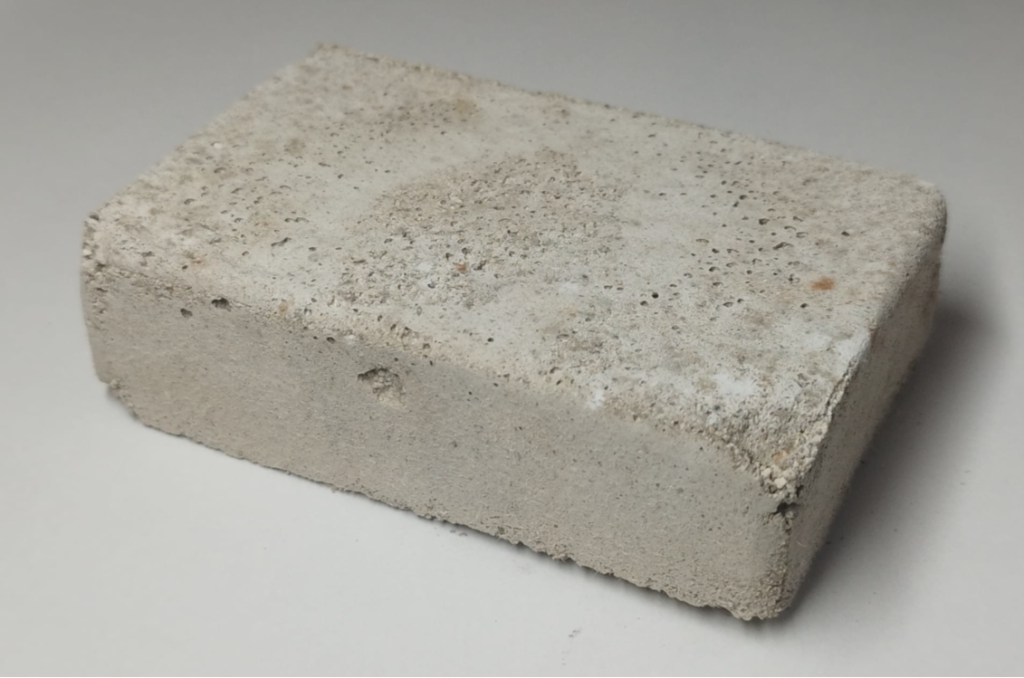
Sample of a recycled-aggregate block consolidated using products generated by Sutcliffiella cohnii.
Microstructure, Mechanical Properties, and Modeling
In parallel, the CTU team conducted a detailed mapping of the microstructure of the cemented specimens using SEM, EDS, XRD, TGA, and nanoindentation, and linked the experimental data to a micromechanical model.
This model explained the relationship between the decrease in porosity and the increase in the effective Young’s modulus and confirmed that the observed stiffness trends can be predicted from microstructural parameters.
Project Outputs and the Path Toward Further Technology Development
The outputs also included review and methodological publications summarizing the possibilities for using bacteria in the recycling of the finest fractions of concrete waste, as well as work assessing the environmental benefits, including collaboration with the University of Salford and Johannes Gutenberg University Mainz on life-cycle assessment and material microstructure characterization.
During the course of the project, nine peer-reviewed publications were produced in impacted journals and in the proceedings of international conferences, most notably articles published in Cement and Concrete Composites, Powder Technology, Journal of Cleaner Production, and Reviews in Environmental Science and Bio/Technology.
The final evaluation by GA ČR rated the project as excellent and confirmed that its objectives had been fulfilled.
The project’s achievements are not confined to publication and citation counts. A stable interdisciplinary team was established, doctoral candidates and students were engaged in addressing a real-world applied problem, international collaboration was established with MICP experts, and a preliminary dialogue was opened with an industrial partner regarding possibilities for further scaling of the technology.
The project thus delivered not only laboratory proof of concept but also a rationale for supporting further research into recycling technologies that align with national R&D&I priorities in the field of environmentally friendly materials and new recycling processes.
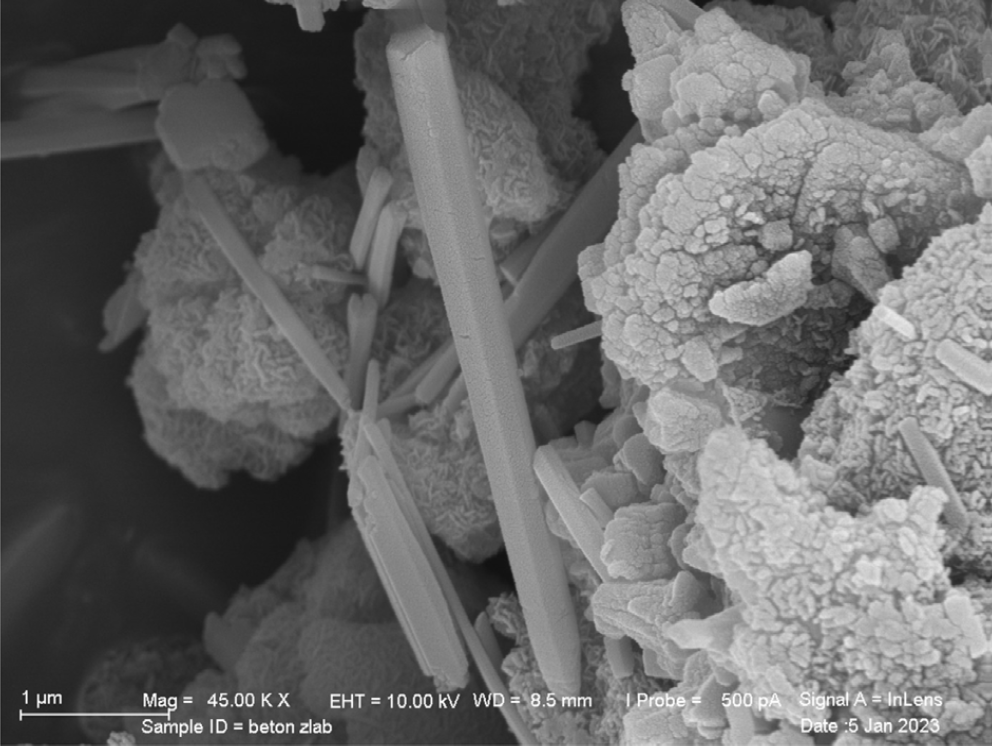
Cover image: Calcite and aragonite crystals on the surface of grains from the fine fractions of waste concrete.