Mathematical disciplines are often perceived by society as something intimidating. Yet, if one overcomes this fear—or even finds enjoyment in mathematics—hidden beauty may be discovered. For instance, mathematics allows us to play with real-world problems. Using functions, equations, and inequations, we can describe and solve practical challenges. Mathematical modeling and optimization form a discipline dedicated to representing and solving such problems. The quality of these models and solutions ultimately depends on how well we formulate them, and on how precisely we can compute or instruct the computer to do so.
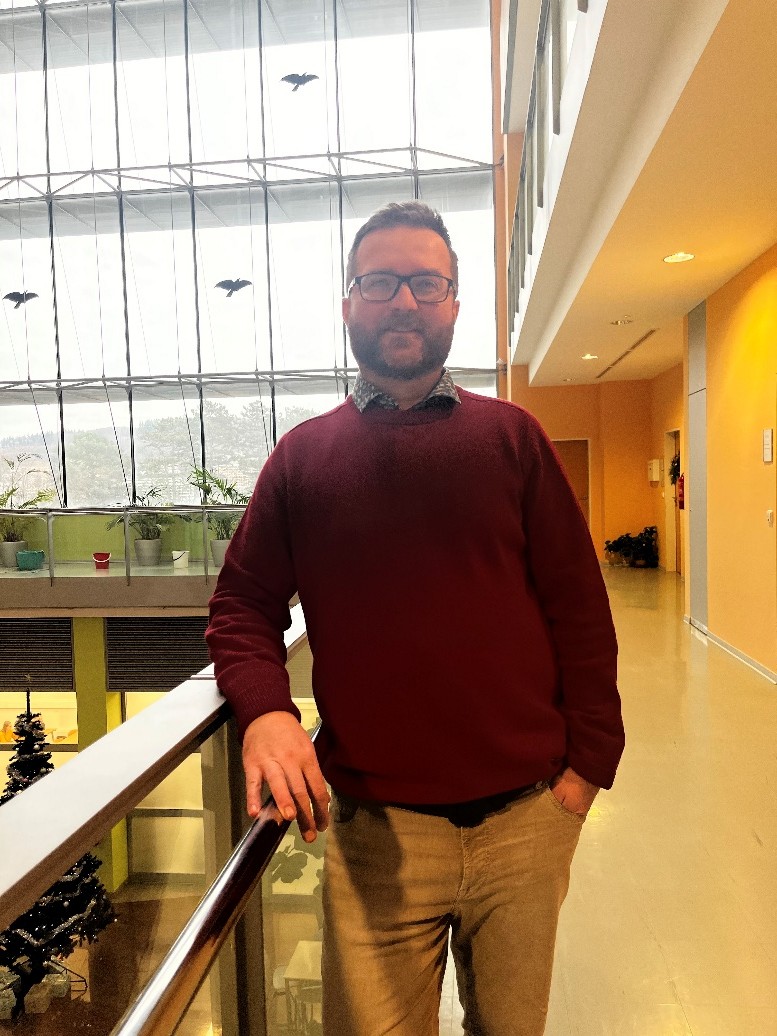
Within his Junior Grant Project, carried out between 2020 and 2022, Dušan Hrabec from the Faculty of Applied Informatics at Tomas Bata University in Zlín focused on developing mathematical models and optimization methods for waste management. Together with his team, he explored how to design efficient waste collection routes, how to optimize the placement and capacity of waste treatment facilities, and how to strategically locate bins and containers.
Logistics in Waste Management
Researchers, in collaboration with colleagues from Brno University of Technology and others, worked on mathematical modeling of logistics problems—mainly facility location tasks—arising in waste management. They investigated the interaction between generated waste quantities and logistics planning, i.e., how the amount of waste affects the capacity of planned or existing facilities. Not only the quantity but also the composition of waste is difficult to predict. One of the main challenges lies in modeling waste generation itself. The key question is whether such parameters can be considered deterministically known or whether they must be estimated and modeled in a more complex way.
These tasks can be classified based on the availability of information at the time of decision-making. If all the data are known in advance, the problem is deterministic. However, in many cases, the data are uncertain and must be modeled. For instance, the amount and type of waste a new incineration plant will process cannot be precisely known at the time of its construction. In such cases, stochastic models are used, providing a more realistic representation. From a research perspective, such problems are not only more interesting but also more challenging to formulate and solve.
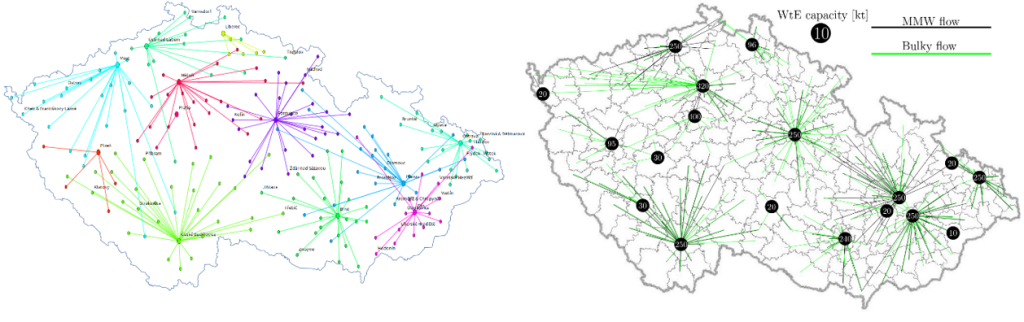
Illustrative results of the so-called location-allocation problems for optimal placement of treatment facilities
The team successfully developed and solved several types of location models, determining, for example, how to optimally place waste treatment centers or design a network of collection bins. Such models typically lead to integer programming problems, which are computationally demanding due to their combinatorial nature. Depending on their structure, they can be formulated either as mixed-integer linear models or mixed-integer nonlinear models. The team from TBU managed to model and solve both categories effectively. Furthermore, they proposed an approach for tackling large-scale problems by using clustering techniques, breaking down otherwise intractable problems into smaller, solvable subproblems.
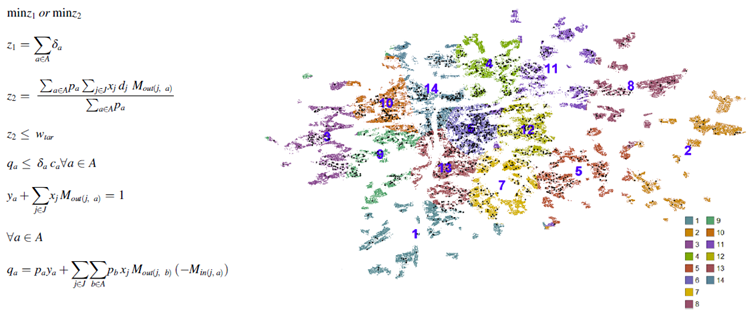
Optimization model for a location problem solved using a combination of clustering and optimization algorithms
Results with International Impact
The results were first presented at prestigious international scientific conferences and later published in leading journals in operations research, logistics, and waste management. The team even achieved more publications and results than originally anticipated in the grant proposal.
Several tasks were carried out in cooperation with foreign institutions with which Dr. Hrabec had previously collaborated. These included researchers at Molde University in Norway, who are experts in both mathematical modeling and algorithm development for integer programming problems, as well as academic consultations with scientists from the University of Vienna, specializing in algorithms for solving complex optimization problems.
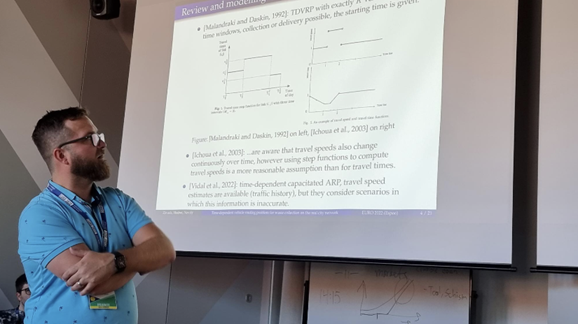
Presentation of results at the EURO conference (July 2022, Helsinki, Finland)
D. Hrabec, Faculty of Applied Informatics, TBU in Zlín
Path to Models in Logistics and Waste Management
Dušan Hrabec has been passionate about mathematics since childhood. During his studies in Mathematical Engineering at Brno University of Technology, he became particularly attracted to applied mathematics. For him, seeing practical results from abstract calculations was a unique experience. During his master’s studies, he spent an Erasmus semester at a logistics school in Norway—a country where nature, logistics, and sustainability are strongly interconnected. This confirmed his decision to pursue mathematical modeling and optimization. He continued with a Ph.D. in applied mathematics, already specializing in logistics applications. International research stays and interactions with distinguished professors and researchers sharing the same passion further shaped his academic path. Finally, inspiration and motivation from his colleagues at Brno University of Technology, who applied logistics to waste management, led to the successful Junior Grant Project dedicated to this very topic.