Skip to content
Mgr. Pavel Němec, Ph.D.
Project of Mgr. Pavel Něměc, Ph.D. from the Faculty of Science, Charles University in Prague revealed the anatomical nature of bird intelligence and therefore solved the mystery why some birds are extremely intelligent although their brains are small. The research of Mgr. Pavel Němec, Ph.D. proved that small brains of birds contain substantial number of neurons. Despite the fact that the largest brains of Passeriformes weigh around 16 grams and the largest brains of parrots weigh about 25 grams, the brains contain equal number of neurones as primate brains which are significantly larger. This research proved that neither absolute nor relative size of the brain is a proper measure of cognitive abilities. It is rather dependent on the cellular composition and neural density. The results of the research were reported by the media worldwide.
doc. Ing. Filip Šroubek, Ph.D., DSc
Project of doc. Ing. Filip Šroubek, Ph.D., DSc. from the Institute of Information Theory and Automation of the Czech Academy of Sciences was aimed at the blurred photographs. Doc. Ing. Filip Šroubek, Ph.D., DSc. and his team developed mathematical models which enable to refocus blurred digital photographs. The main step of this project was to precisely mathematically model the process of image scanning. It is possible to use this method in photography and other fields such as astronomy, ophthalmology or nuclear medicine. The results were published in 15 scientific journals and were presented at many prestigious foreign conferences.
Prof. RNDr. Blanka Říhová, DrSc.
Project of Prof. RNDr. Blanka Říhová, DrSc. from the Institute of Microbiology of the Czech Academy of Sciences brought hopeful results in the field of tumour cells and cytostatic agents. The current advancement in chemotherapy is mainly aimed at the development of new types of cytostatic agents with lower toxicity which inhibit the creation of resistance. The resistance to particular cytostatic agent and multidrug resistance (MDR) is a frequent reason for the failure of chemotherapy. The project team brought new findings proving that the systems for medicaments transfer based on HPMA copolymer conjugates carrying cytostatic agents and P-gp inhibitors are capable to effectively overcome gained and natural multidrug resistance. The results were published in series of scientific journals in the Czech Republic and abroad.
Mgr. Sylvie Graf, Ph.D. and doc. PhDr. Martina Hřebíčková, Dr., DSc.
Project which was carried out by Mgr. Sylvie Graf, Ph.D. and doc. PhDr. Martina Hřebíčková, Dr., DSc. from the Institute of Psychology of the Czech Academy of Sciences focused on the possible approaches to prejudice reduction. The scientists concentrated on relationships between participants from neighbouring nations in Central Europe. Based on the unique data from Central Europe, the two scientists have proven that negative experience has a relatively higher impact on increasing prejudice than positive experience on decreasing it. However, the positive experience occurs more frequently which then ultimately balances and reduces the higher impact of negativity on the prejudice. Outcomes of this project are presented in the monography “Czechs and their neighbours. Intergroup attitudes and contact in Central Europe.” and article in “European Journal of Social Psychology”.
On Monday 17 June 2019, the top representatives of GACR, FWF (Austria), NCN (Poland), ARRS (Slovenia) signed the ‘’CEUS – Central European Science Partnership” Lead Agency Agreement: Memorandum of Understanding on the unilateral administration and mutual recognition of evaluation procedures”. This new collaboration will enable scientists from the Czech Republic, Austria, Poland and Slovenia to carry out scientific projects with new foreign partners based on the Lead Agency evaluation, which belongs to the most preferred forms of cooperation among foreign agencies supporting basic research in reducing administrative burdens. As part of the CEUS Initiative to support basic research in the Central European Region, researchers will now be able to submit bilateral and trilateral LA based project proposals.
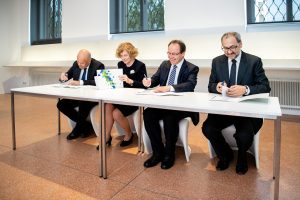
GACR currently plans to announce the first call within this new initiative next year. At the end of June this year, The Research, Development and Innovation Council approved a new material enabling the agency to launch multilateral projects based on the Lead Agency principle. At this point, the material will be submitted to the Czech government for approval.
On 5 November 2018, GACR President signed a Memorandum of Understanding with the São Paulo Research Foundation (FAPESP). As a result of this agreement, Czech scientists have the opportunity to expand their basic research activities abroad. In case of this new cooperation, project proposals were submitted for the first time in 2019. This cooperation is based on bilateral level with project duration of three years.
On Monday 15 October 2018, GACR President Dr. Alice Valkárová met with the Deputy Minister of Science and Technology Taiwan (MOST) Yu-Han Tsou accompanied by a delegation of representatives from the National Synchrotron Radiation Research Center (NSRRC) and the National Applied Research Laboratories (NARLabs) to discuss the possibilities for developing bilateral cooperation between the two agencies.
On 14 May 2018, GACR President signed a Memorandum of Understanding with the Russian Foundation for Basic Research (RFBR) in Moscow. As a result of this Memorandum, Czech scientists have the opportunity to expand their basic research activities abroad. The first call was announced this year and is based on bilateral cooperation with project duration of three years.
On 4 and 5 April 2018, the working group with provisional name – Central Europe Initiative (CEI) met in Prague to discuss the future possibilities of cooperation on the principle of Multilateral Lead Agency between involved national grant agencies.
The Prague meeting followed the Ljubljana and the Vienna meetings. Heads of individual research grant agencies together with their representatives and members from international divisions participated in the discussions.
A joint agreement was reached that the first call will start with bilateral and trilateral projects in basic research on the bottom up principle. The most crucial task for all involved agencies will be harmonizing legal regulations, which the agencies abide by and which differ in each country.
The founding members of this initiative apart from the Czech Republic (Czech Science Foundation) are Poland (National Science Centre), Slovenia (Slovenian Research Agency), Austria (FWF Der Wissenschaftsfonds) and Hungary (National Research, Development and Innovation Office). Observers of the negotiations were representatives from Slovakia (Agentúra na podporu výskumu a vývoja), Croatia (Croatian Science Foundation) and Switzerland (Swiss National Science Foundation), who also represented Science Europe as an observer.
