There are hundreds of thousands of known asteroids in the Solar System. We have detailed information on only a few thousand of them so far. The Czech Republic is a world power in creating models of these cosmic bodies. The GACR project “A big picture of the main asteroid belt – physical properties of asteroids derived by inversion of optical and infrared photometry” focused on the analysis of data on asteroids. The team led by doc. Mgr. Josef Ďurech, Ph.D., achieved to describe more than a thousand new cosmic bodies.
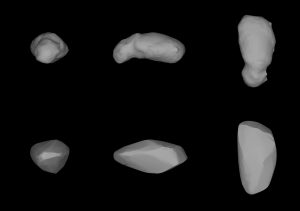
In the area of asteroids modelling, the Czech Republic is the most productive in the world and these models are used by scientists around the world for further research and measurement. The results also serve for further basic research, for example to derive and obtain further information about the asteroid, such as its thermophysical parameters etc.
doc. Mgr. Josef Ďurech, Ph.D.
Astronomical Institute of Charles University
Most of us perhaps know that we divide burns by intensity into four basic groups. Even though extensive burns can be fatal, modern ways of treatment greatly improved the treatment results. Scientists are currently working on full replacement of the burnt skin.
One of them is Ing. Alena Řezníčková Ph.D., who has been dealing with this task for three years as part of the project “Physically deposited and anchored metal nanostructures on solid substrate”. The main objective of the project was to modify the surface of the sample, polymer or glass, using physical and chemical methods to improve its properties for medical and electronics applications. The polymeric substrate itself is inert and therefore not suitable for other applications.
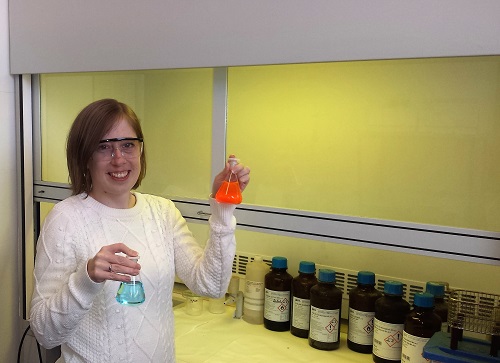
Ing. Alena Řezníčková Ph.D.
Department of Solid State Engineering
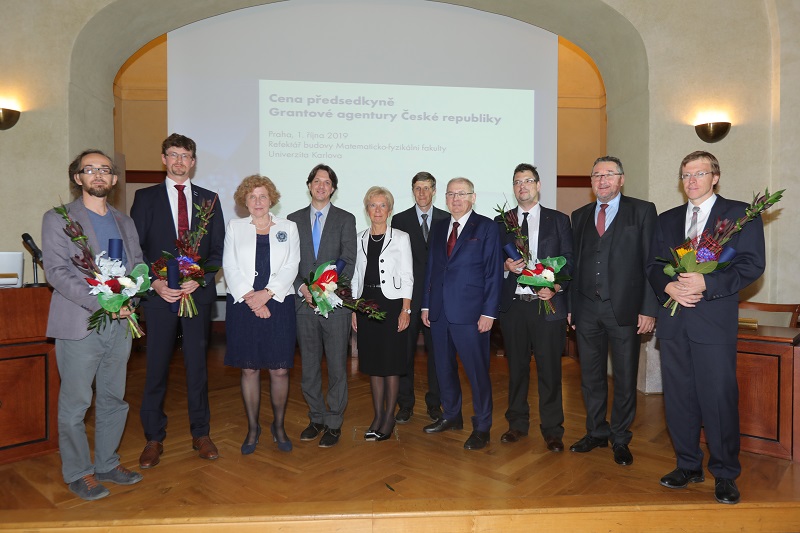
Five Principal Investigators of the top basic research projects received the GACR President’s Award 2019. In contrast to last year, when one female investigator was awarded, male investigators dominated this year’s award.
Zdeněk Sofer succeeded with a project investigating the application of ion beams for modifications of graphene-based structures. Jiří Bruthans examined the effect of gravity-induced stress on sandstone erosion. Marek Mráz’s project focused on studying the regulation of B cell receptor (BCR) signalling pathway by microRNAs. Laureate Václav Štětka analysed the role of social media in transformation of political communication and citizen participation in the Czech Republic. Another laureate, Robert Černý, focused on oro-pharyngeal interface during vertebrate primary mouth formation. The GACR presidium decided on the winners among dozens of different projects.
“Yet again, choosing the best projects has been extremely difficult this year. We face the challenge of selecting the best projects among dozens of projects every year. On the other hand, it is a good message on how brilliant scientists in our country are. Congratulations to award winners, their projects were indeed excellent,” Alice Valkárová, the GACR president, stated.
The GACR President’s Award was established in 2003. Since then, 69 awards have been given in response to the excellent results in carrying out basic research projects supported by GACR. This year’s five awarded projects were selected out of 448 projects that ended last year, based on proposals of the respective discipline committees. The GACR presidium decided on the final selection of projects for the GACR President’s Award this April.
The prize is awarded for excellent results in basic research projects that had been supported by GACR. The Principal Investigators of the chosen projects and their co-workers receive a financial reward. Every year, the award goes to four to five Principal Investigators, whose projects were completed in the previous year, received a nomination for the award and acquired excellent evaluation by expert advisory bodies.
